

Rest Stops
When action turns into awareness

This week, during a discourse on Upadesha Sara by Bhagavan Ramana Maharshi, an unexpected word caught my attention.
Flow.
The teacher, Brahmacharini Shubhani Chaitanya of the Chinmaya Mission in New York, whose soft voice and thoughtful explanations make Vedanta feel lived rather than abstract, spoke about the four classical paths in Vedanta:
Karma Yoga or action
Bhakti Yoga or devotion
Ashtanga Yoga or meditation
Jñāna Yoga or knowledge
Each path, she explained, contains within it an ideal state: a moment when the sense of “I am doing this” dissolves.
The doer disappears into the doing.
The singer becomes the song.
The dancer becomes the movement.
The writer becomes the writing.
The scholar becomes the question.
For a brief moment, the distinction between subject and object—between “me” and “my work”—dissolves.
Modern psychology calls this flow state.
Vedanta would say it is a glimpse of something deeper—the witness state, or Sākṣī—where one rests even as they perform the action.
Brahmacharini Shubhani Chaitanya called these moments “rest stops”— brief pauses in the midst of movement.
Resting Within Action
Most of us do not associate work with rest.
We associate it with striving. Deadlines. Comparison. The subtle measuring of output and worth.
I began to think about the moments in my own life when work has felt different.
There are days when writing feels like chiseling stone—deliberate, effortful, heavy. And then there are days when something shifts. The mind quiets. Sentences flow without force. Time loosens its grip. Hours pass unnoticed.
In those moments, I am not thinking about approval or performance. I am not thinking about what the piece will achieve.
I am simply inside it.
Absorbed.
And paradoxically, those are the moments when the work does not exhaust me.
It steadies me.
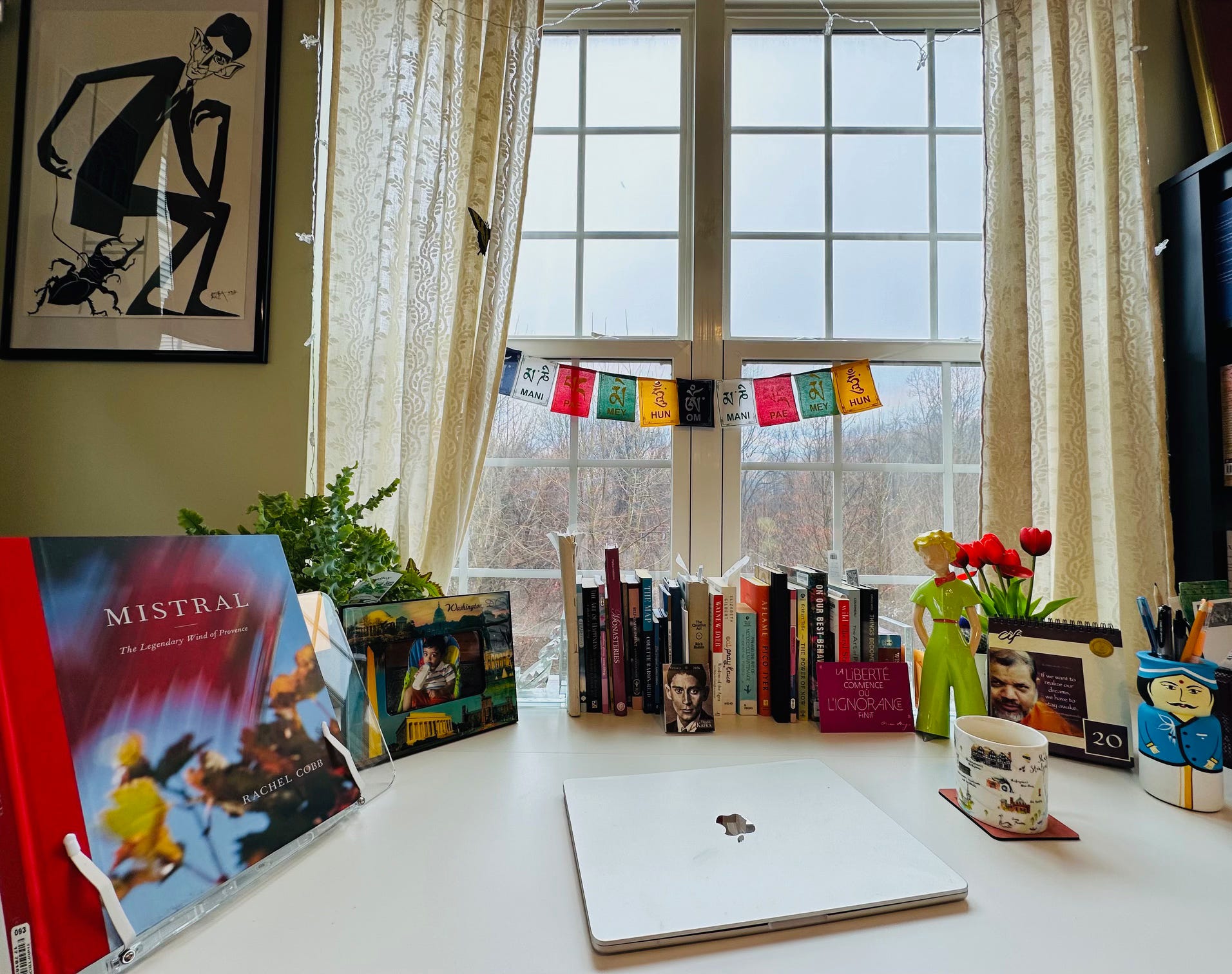
Entering the Work
History offers similar portraits of absorption.
Johann Melchior Dinglinger, the Baroque goldsmith in the court of Augustus the Strong, the Elector of Saxony, spent years crafting intricate dioramas—miniature worlds in enamel and precious stones. His depiction of the Mughal emperor Aurangzeb’s court was not hurried. It was devotion translated into form over the course of eight years.


Almost a contemporary of Dinglinger, English clockmaker John Harrison devoted decades to solving the problem of measuring longitude at sea. His marine chronometer, H4, emerged from relentless refinement—time itself becoming his companion.

These men were not merely producing objects. They were inhabiting them.
There is a difference between completing a task and entering it.
In Vedantic language, when the doer dissolves into the doing, the ego—that constant and restless narrator of success and failure—recedes. Action continues, but the agitation around it softens.
The four yogas are not separate silos but converging paths. Whether through action, devotion, meditation, or inquiry, the aim is the same: to loosen identification with the small self, or ego, and glimpse a larger field of being.
Flow, then, is not merely a performance advantage.
It is a spiritual reminder. A reminder to take a rest stop in the middle of our striving.
A preview of what it feels like when we are not pushing against life but participating in it. And being one with it.
Different Doors, Same Room
This does not mean every moment of work will feel serene. Life remains messy, interrupted, and imperfect.
There are drafts that resist. Conversations that unsettle. Days when the mind circles without relief.
Vedanta does not promise uninterrupted calm.
It offers something subtler: a shift in identification.
When the doer dissolves—even briefly—what remains is clarity. The measuring voice—Is this good enough? How will this be received?—grows quieter.
Vedanta invites us to find calm even in the storm — and with practice, that calm becomes more familiar than the turbulence.
In Karma Yoga, one acts fully, releasing attachment to the fruits.
In Bhakti Yoga, one practices devotion fully, without bargaining.
In Ashtanga Yoga, one disciplines attention until distraction thins.
In Jñāna Yoga, one inquires until the inquirer itself becomes transparent.
Different entry points. Same destination. We recognize that we are not merely the role we occupy or the output we produce.
We are the awareness in which all of that arises.
Flow is not permanent. It flickers. It arrives unexpectedly and leaves just as quietly.
But in moments of absorption—when writing writes itself, when music carries the musician—we glimpse something essential: we glimpse an inner rest stop, even as motion continues.
And perhaps that is why such moments nourish rather than deplete. We are no longer standing outside ourselves evaluating performance.
We are whole.
I find this especially meaningful in seasons when outer identity shifts—when projects pause and the next step is still forming. In such seasons, it is tempting to measure worth through visible milestones.
But absorption offers another metric: to be fully present with what is here.
To give undivided attention to the paragraph, the conversation, and the question.
Not as a means to an end.
But as participation in something larger than the restless self.
Stillness in Motion
Perhaps that is the quiet promise hidden in the four yogas. Not escape from the world. Not withdrawal from responsibility. But intimacy with the present moment.
Be one with what you are doing.
Let the doing be complete.
And in that completeness, notice what remains when striving softens. Not emptiness. Not achievement.
But steady awareness.
Stillness in motion.
The rest that was there all along.
As Brahmacharini Shubhani Chaitanya reminds us, we can learn to notice—and gently cultivate—a few more rest stops along the way.
Meaningfully yours,
Anu Prabhala